Hospital & Bedside Notary Services in Sacramento
When a signing can't wait, our notaries come straight to the patient's bedside at any hospital in Sacramento and the surrounding counties. Same-day and after-hours visits available.
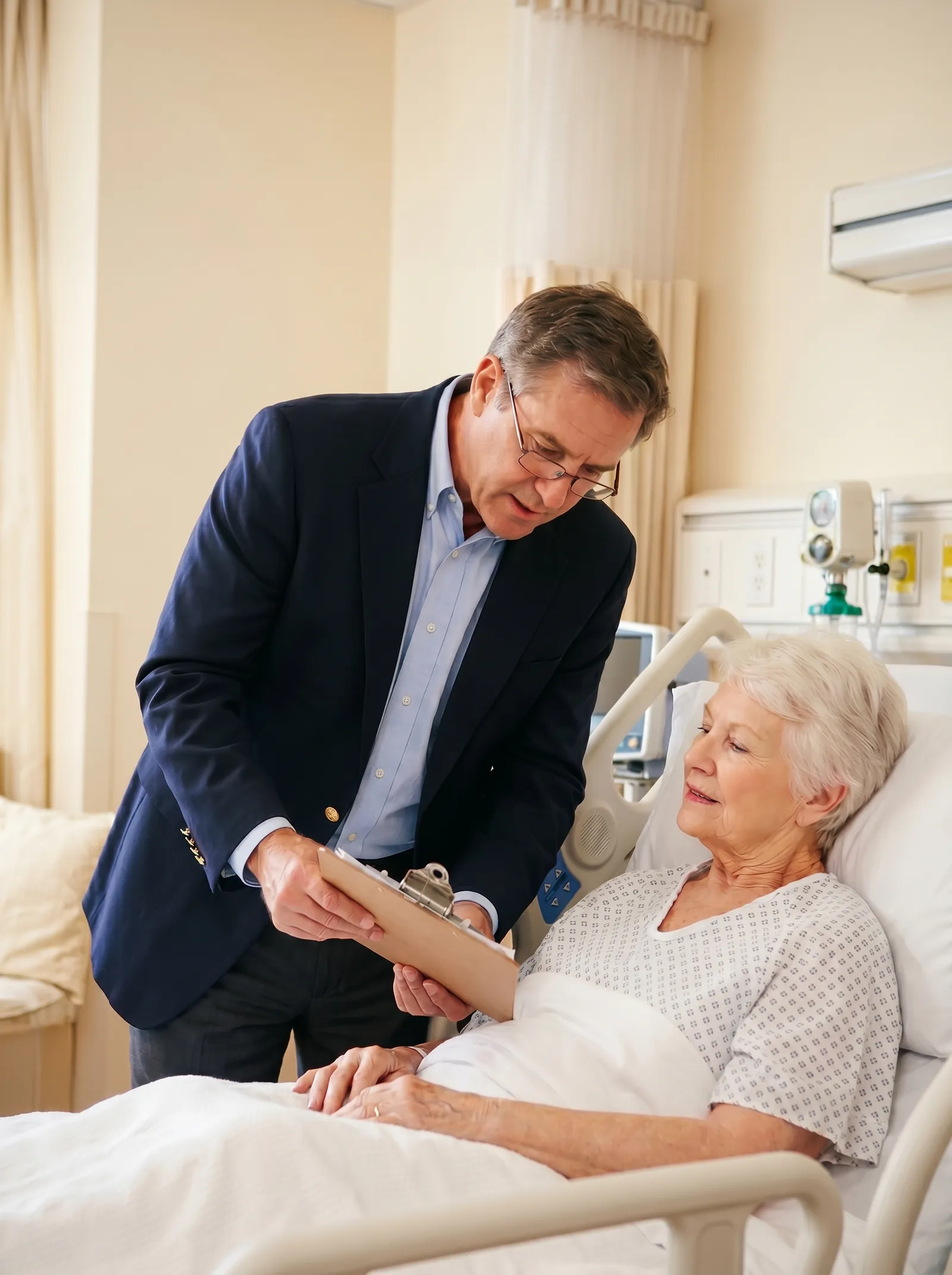
Bedside notary, Sacramento
When the Signing Can't Wait
Yes, a notary can come to the hospital, and often the same day you call.
When someone is admitted, urgent paperwork tends to surface fast. A family needs a power of attorney to handle a parent's affairs. A patient facing surgery wants an advance healthcare directive in place before morning. The signer usually can't get to a notary's office, so our notaries come to them.
We make bedside visits to hospitals across the Sacramento region, work quietly around nurses and staff, and handle wills, directives, and powers of attorney with the seriousness they deserve. Coordinating from out of town for a parent or relative? We'll walk you through exactly what's needed and keep you in the loop before and after the visit.
Why families call an independent notary
Most hospitals do not notarize patients' personal legal documents, and nurses and case managers generally cannot either. Our notaries are independent of the hospitals we visit, arrive discreetly at the bedside, and are trained to keep a serious moment calm. We come to you, often the same day you call.
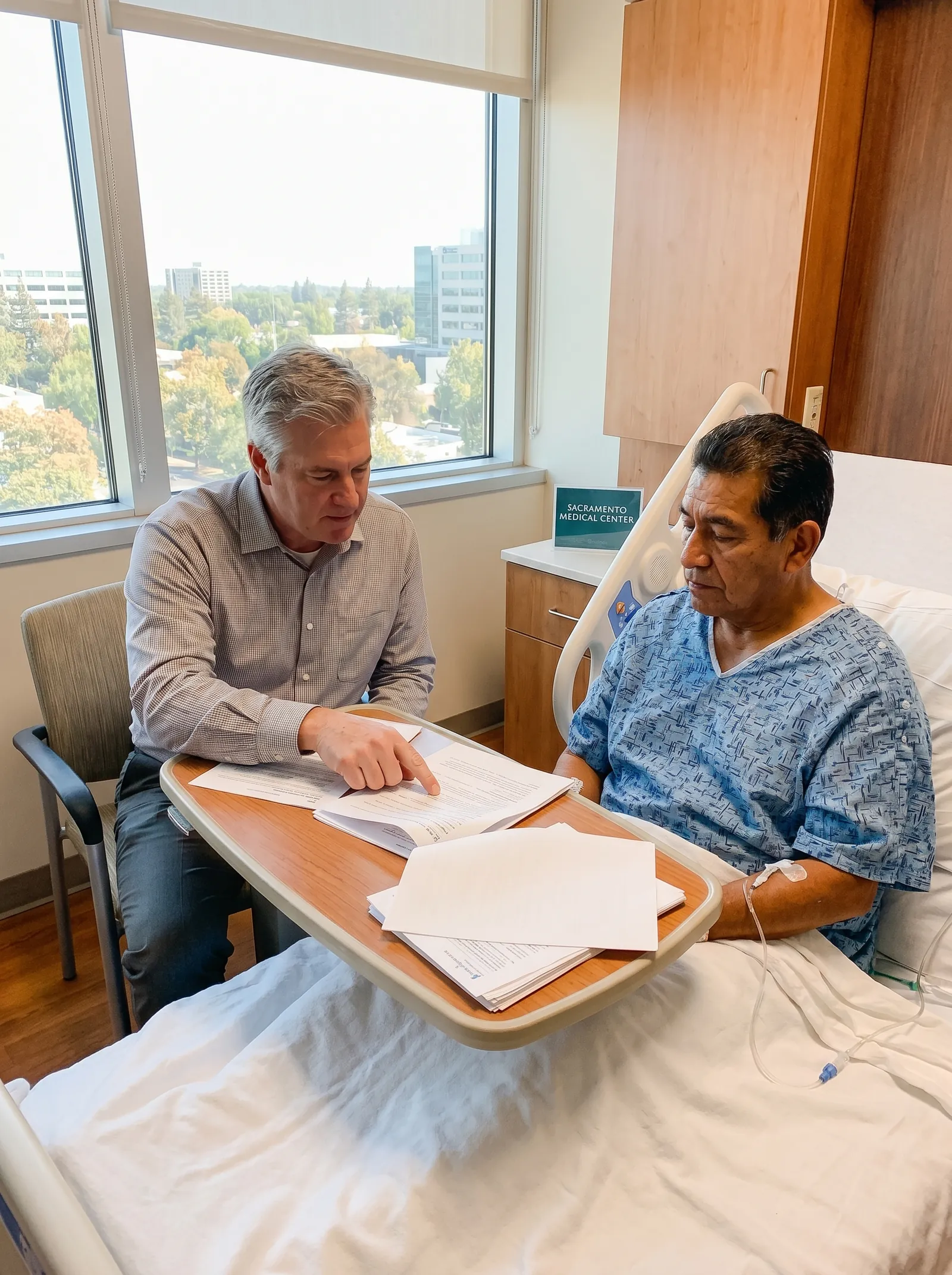
Simple, calm, and quick
How a Hospital Notary Visit Works
- Call Us With the Details
Tell us the hospital, the patient's room or unit, what's being signed, and how soon you need someone. We'll confirm a notary and a time, often the same day.
- We Make Sure the Signer Is Ready
The patient needs to be awake, aware of what they're signing, and able to tell the notary directly that they agree to it. Have a valid photo ID on hand. If there is no ID at all, California allows credible witnesses instead, but a credible witness cannot be named in the document and cannot stand to gain anything from it, so call us first and we will go through who can serve.
- We Come to the Bedside
Our notary checks in through the front desk or nursing station, then works at the bedside, fitting in around staff and visitors without disrupting care.
- We Verify ID and Witness the Signing
We confirm identity, watch each signature, complete the notarial certificate, and apply the seal.
- You're Done
Most single-document visits take about 15 to 20 minutes. If your documents require witnesses, we can arrange them in advance.
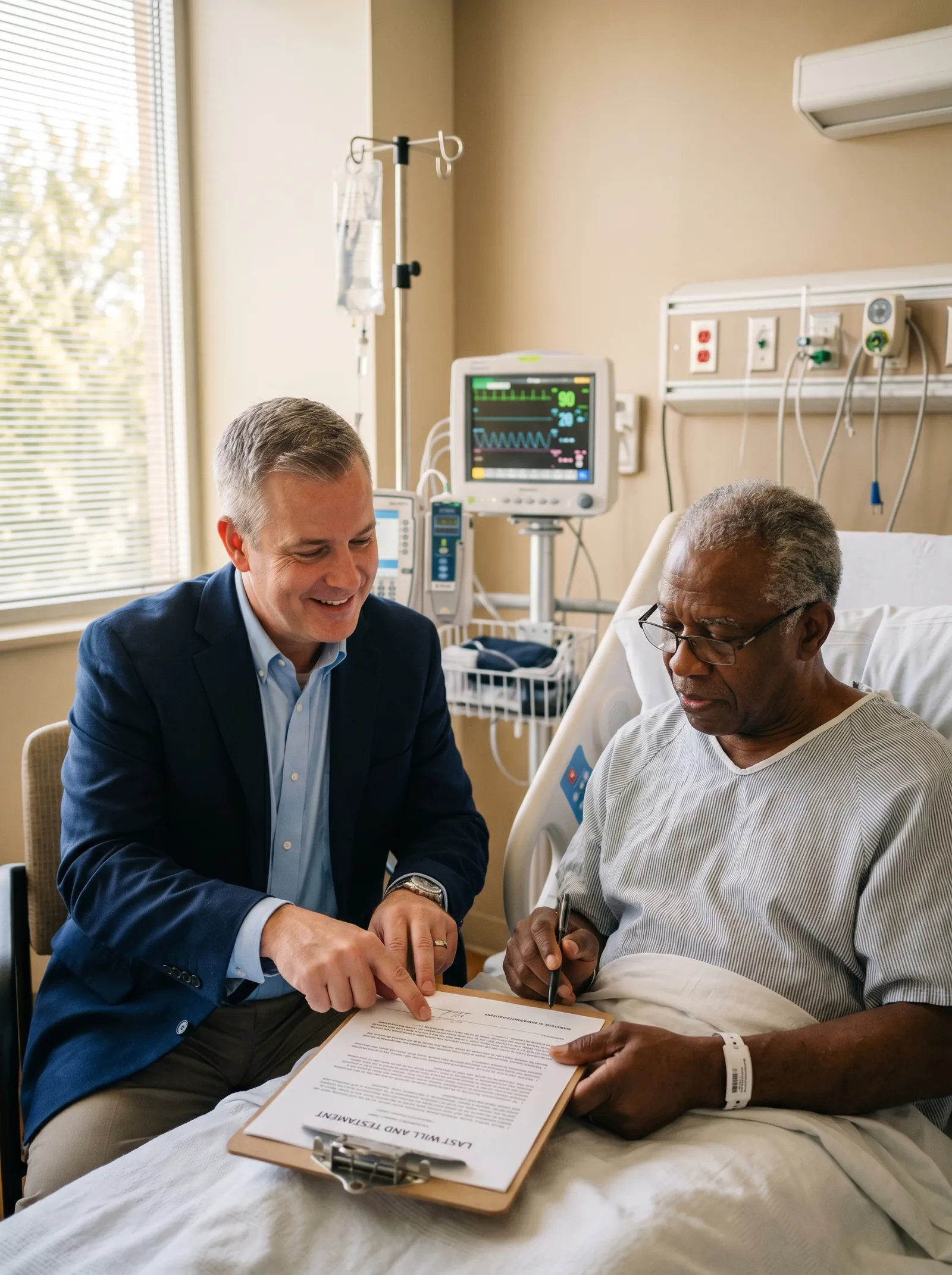
At the bedside
What We Notarize at the Bedside
The documents that most often bring a notary to a hospital room, handled with care and discretion.
This is not a complete list. If you don't see your document, just ask. If it can be notarized in California, we can almost certainly handle it at the bedside.
Before the visit
What the Patient Will Need
A few things have to be in place before any notary, anywhere, can complete a hospital signing. Knowing them ahead of time keeps the visit short and avoids a wasted trip.
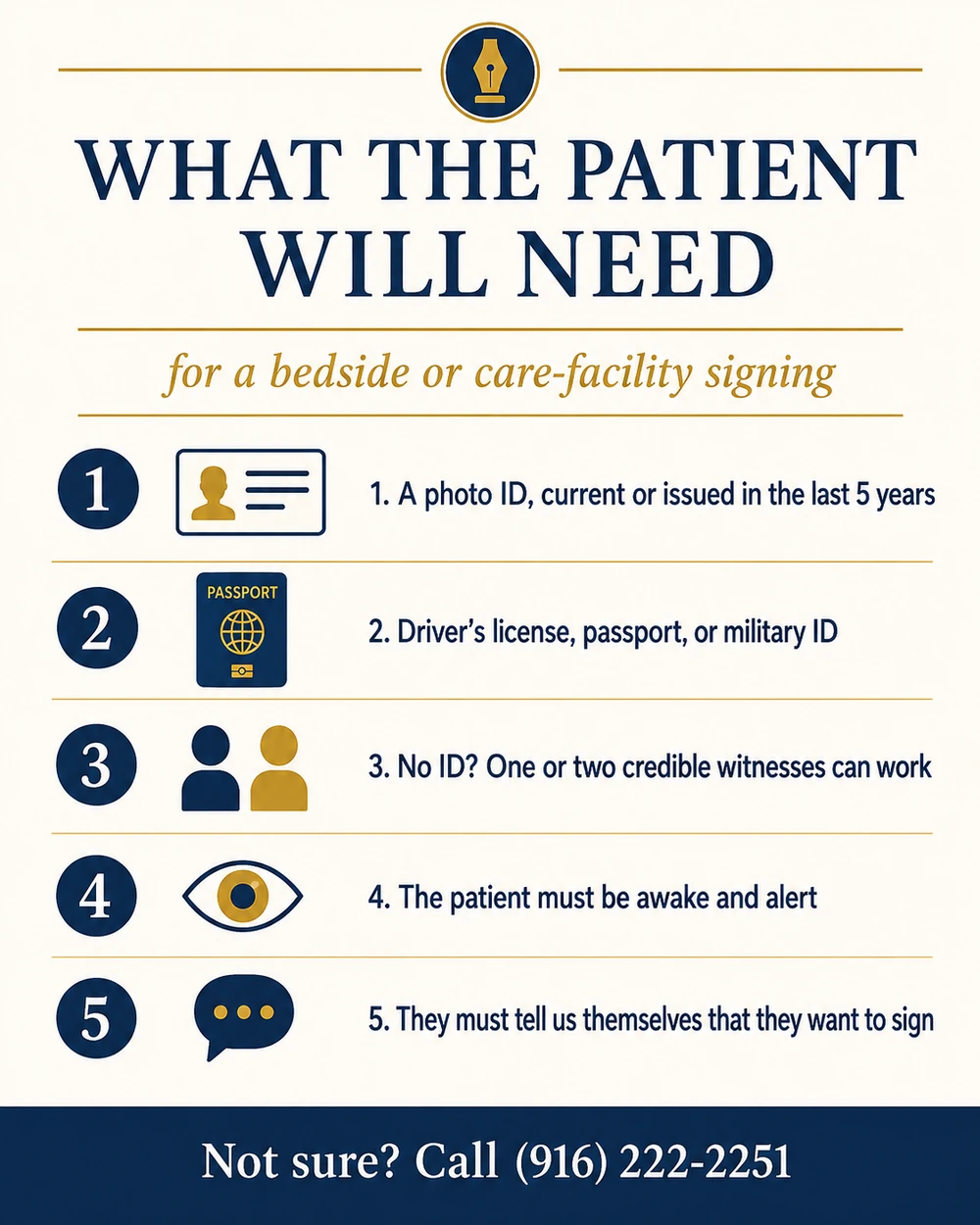
- A valid photo ID. A driver's license, state ID, DMV senior citizen ID card, passport, or military ID that is current, or was issued within the past five years, is the simplest path. If the patient has no ID at all — lost, stolen, or never issued — there is still a way forward, using credible witnesses (see the note just below). An ID sitting at home does not qualify under California law, so if anyone can fetch it, that is the faster route.
- The ability to understand and agree. The signer must be awake, aware of what the document is, and able to communicate that they're signing willingly. A notary cannot proceed if a patient is unconscious, heavily sedated, or unable to respond, and legally, no notary can.
- The complete, unsigned document. Bring the full document, but don't sign it ahead of time. California requires the signature to happen in front of the notary.
- Witnesses, if the document calls for them. Some documents (and signature-by-mark situations) need witnesses. Hospital staff usually can't serve in that role, so tell us when you call and we'll talk through your options.
If the patient has no acceptable ID
California law (Civil Code §1185) still lets the signing go ahead, using credible identifying witnesses. Here is how it works, so you can line it up before we arrive:
- One witness who knows our notary, or two who don't. Either one credible witness who personally knows the signer, is also personally known to our notary, and shows their own ID; or two credible witnesses who personally know the signer and each show their own valid ID. Either route requires that the signer have no acceptable ID to present — one that is simply at home has to be brought in.
- Each witness swears to the signer's identity. Under oath, every witness confirms the signer is the person named in the document and that they personally know them.
- The witnesses must be impartial. A witness cannot be named anywhere in the document and cannot have any financial or beneficial interest in it, so someone who inherits or gains under the document cannot serve.
- Their ID must be current. Each witness presents a valid government-issued ID that is current or was issued within the past five years.
Not sure who can serve as a witness? Tell us when you call and we'll help you sort it out before the visit.
A note on capacity
A notary's job is to confirm that the signer is willing and aware at the moment of signing, not to make a medical or legal judgment about their competence. If there's any question about a patient's ability to understand the documents, due to sedation, a stroke, or another condition, families should speak with the patient's physician and, ideally, an attorney before scheduling. Our notaries are trained to recognize and speak up about concerns, and we'll always pause if something doesn't seem right.
Call us before you book and tell us the situation. Describe the document, how the patient is doing today, and what ID they have with them, and our notary will tell you exactly what the signing needs. That call is free and it is the best way to avoid a wasted visit. Please do make it: if our notary arrives and the signer cannot be identified, cannot understand the document, or cannot communicate their agreement, the law does not allow us to notarize, and the travel fee still applies because the trip was made.
Where in the building
Which Parts of the Hospital We Come To
People often assume a bedside notary only works in a regular patient room. It doesn't. We meet the signer wherever they are in the building, as long as the unit allows visitors and the signer is awake and able to agree. Tell us which part of the hospital when you call, because a few of them change how the visit goes.
- The emergency room (ER). More common than people expect, and usually the same situation: someone waiting on a bed who needs a power of attorney or a healthcare directive handled before they are admitted. It works. But the ER is the least predictable place in the hospital, and if the patient is taken for imaging, given something for pain, or moved upstairs partway through, the signing stops where it stops. Say "ER" when you call so our notary knows what they are walking into.
- Inpatient rooms, step-down and rehabilitation units. The most straightforward setting, and where most bedside signings happen.
- ICU and critical care. Whether a notary can come in is the unit's call, not ours, and it can change day to day. Ask the patient's nurse what visiting looks like before you call us, so nobody makes the trip for nothing.
- Before a procedure, not after. If a signing has to happen around surgery, do it in pre-op. Once a patient has had anesthesia or sedation they cannot knowingly agree to anything, and no notary in California may proceed. That one is not a policy we can bend.
- Lobbies, waiting areas and the cafeteria. When the person signing is a family member rather than the patient, we don't need to be at the bedside at all. Any quiet corner of the building works.
Find your hospital
We Come to Every Hospital in the Region
The list below is not the limit. We take bedside appointments at every hospital in the Sacramento region, along with smaller hospitals, surgical centers, and rehabilitation facilities. The ones here are simply the ones we are called to most. Each has its own page with parking, entrances, and unit access, so tap yours for the details. Don't see yours? Call and ask.
Central & East Sacramento
Downtown, Midtown, Oak Park, and East Sac, minutes from our Sacramento notaries.
UC Davis Medical Center
Sacramento's only Level I trauma center and academic medical campus, on Stockton Blvd in Oak Park. Bedside visits to patient rooms, the ICU, and the children's hospital.
Bedside details →Sutter Medical Center
Midtown Sacramento on 29th Street, home to the Anderson Lucchetti Women's & Children's Center. Notary visits across its medical and maternity units.
Bedside details →Mercy General Hospital
East Sacramento near McKinley Park, home to the Alex G. Spanos Heart & Vascular Center. Bedside signings for cardiac and general patients.
Bedside details →Arden, Arcade & Carmichael
North of the American River, covering the Arden-Arcade and Carmichael campuses.
Kaiser Permanente Sacramento (Morse Ave)
The Morse Avenue medical center in Arden-Arcade. We visit patients and family members here as an independent notary service, separate from Kaiser.
Bedside details →Mercy San Juan Medical Center
A Level II trauma center in Carmichael with a Family Birth Center and NICU. Bedside notary visits seven days a week.
Bedside details →Placer County
Across the county line, serving Roseville and the surrounding Placer communities.
Yolo County
West across the causeway, serving Davis and the surrounding Yolo communities.
South Sacramento
The south end of the city, off Highway 99 and within easy reach of Elk Grove and the Pocket.
Don't See Your Hospital?
This list covers the busiest ones. We also visit other hospitals, surgical centers, and rehabilitation facilities around the Sacramento region, along with assisted living, memory care, and skilled nursing residents. See our senior care notary services, or just call and tell us where you are.
Across the region
We Serve Cities Across the Sacramento Region
Our notaries reach hospitals, care facilities, and homes throughout Sacramento and the surrounding counties, not only the cities listed here. These are quick links to a few of the areas we serve most. If you don't see your city, we very likely still cover it, so just call and ask.
Common questions
Frequently Asked Questions
Can a notary come to a patient's hospital room?
Yes. Our notaries come directly to the patient's room at hospitals throughout Sacramento, work quietly around nurses and visitors, and keep the visit calm and brief. Just call us with the hospital, the room or unit number, and the documents involved, and we will arrange a time.
Can you send a notary to the emergency room?
Yes. ER visits are a real part of what we do, and they usually look the same: someone is waiting on a bed and needs a power of attorney or a healthcare directive handled before they are admitted. Two things to know before you call. The emergency room is the least predictable place in the hospital, so if the patient is taken for imaging, given something for pain, or moved upstairs partway through, the signing stops where it stops. And if sedation has left the patient unable to understand what they are signing, no notary in California may proceed, because they can no longer knowingly agree to it. Say "ER" when you call so our notary knows what they are walking into.
Do Sacramento hospitals have notaries on staff for patients?
Usually not. Most hospitals, including Sutter, Kaiser, UC Davis, and Mercy locations, do not provide notary services for patients' personal legal documents, and nurses and case managers generally cannot notarize. That is why families call an independent mobile notary. Our notaries are independent of the hospitals we visit and come directly to the bedside, often same-day.
What does a patient need to have ready for a bedside notarization?
The patient needs a government-issued photo ID such as a driver's license, state ID, passport, or military ID that is current, or was issued within the past five years. If the patient has no acceptable ID at all, California allows credible identifying witnesses who personally know the signer and have their own valid ID. An ID that exists but is sitting at home does not qualify — it has to be brought. The signer must also be awake and able to communicate that they understand the document and are signing willingly.
How much does a hospital notary visit cost?
The notary fee is $15 per notarized signature, which is the maximum allowed under California law. Travel to a hospital is a flat $65 because of the added time, parking, and access involved. The total depends on how many signatures you need and the location. Call or text (916) 222-2251 and we'll confirm the total before we come out. There are no hidden fees. We take cash, credit card, Venmo, PayPal, and Cash App.
Can you notarize for a patient in the ICU or who is sedated?
A notary can only proceed if the signer is conscious, understands what they are signing, and can communicate their consent. A patient who is heavily sedated, unconscious, or unable to respond cannot have documents notarized, and no notary may legally do so. If you are not sure whether the patient is able to sign, call us and describe the situation. We will tell you honestly whether a visit makes sense before anyone schedules one.
Do you offer same-day and after-hours hospital visits?
Yes. Hospital signings are often urgent, so same-day and evening appointments are available and we serve patients seven days a week. Call (916) 222-2251, explain the situation, and we will do everything we can to get a notary to the bedside quickly.
What if the patient is too weak to sign their name?
In many cases this is still workable. California allows a signature by mark, where the signer makes an X while two witnesses observe and sign. This is common for patients who are weak or have limited mobility. Let us know ahead of time so we can confirm the approach and make sure two witnesses are available, since hospital staff usually cannot serve as witnesses.
Request a bedside visit
Need a Notary at a Hospital?
We come to the patient's bedside at any hospital in Sacramento and surrounding counties. Same-day and after-hours appointments available. Call and tell us the situation.
Call or Text(916) 222-2251Request a Bedside Visit
Call now for the fastest response, or send the details and we'll call or text you back. Same-day available.