What Is a Notary Public?
A plain-English guide to what notaries do, when you need one, and why mobile notary is the smarter choice for Sacramento residents.

The basics
A State-Appointed Official
A Notary Public is an official commissioned by the State of California to serve as an impartial witness to the signing of important documents.
Their job is straightforward but critical: verify that the person signing a document is who they claim to be, confirm they are signing willingly and without coercion, and apply an official notary seal that makes the document legally recognized.
Notaries do not provide legal advice, draft documents, or tell you what to sign. They are a neutral third party whose only role is to authenticate the signing process itself.
Never sign before the notary arrives
The notary must personally witness your signature for the notarization to be valid. Signing in advance will require you to start over with a new document.

What to have ready
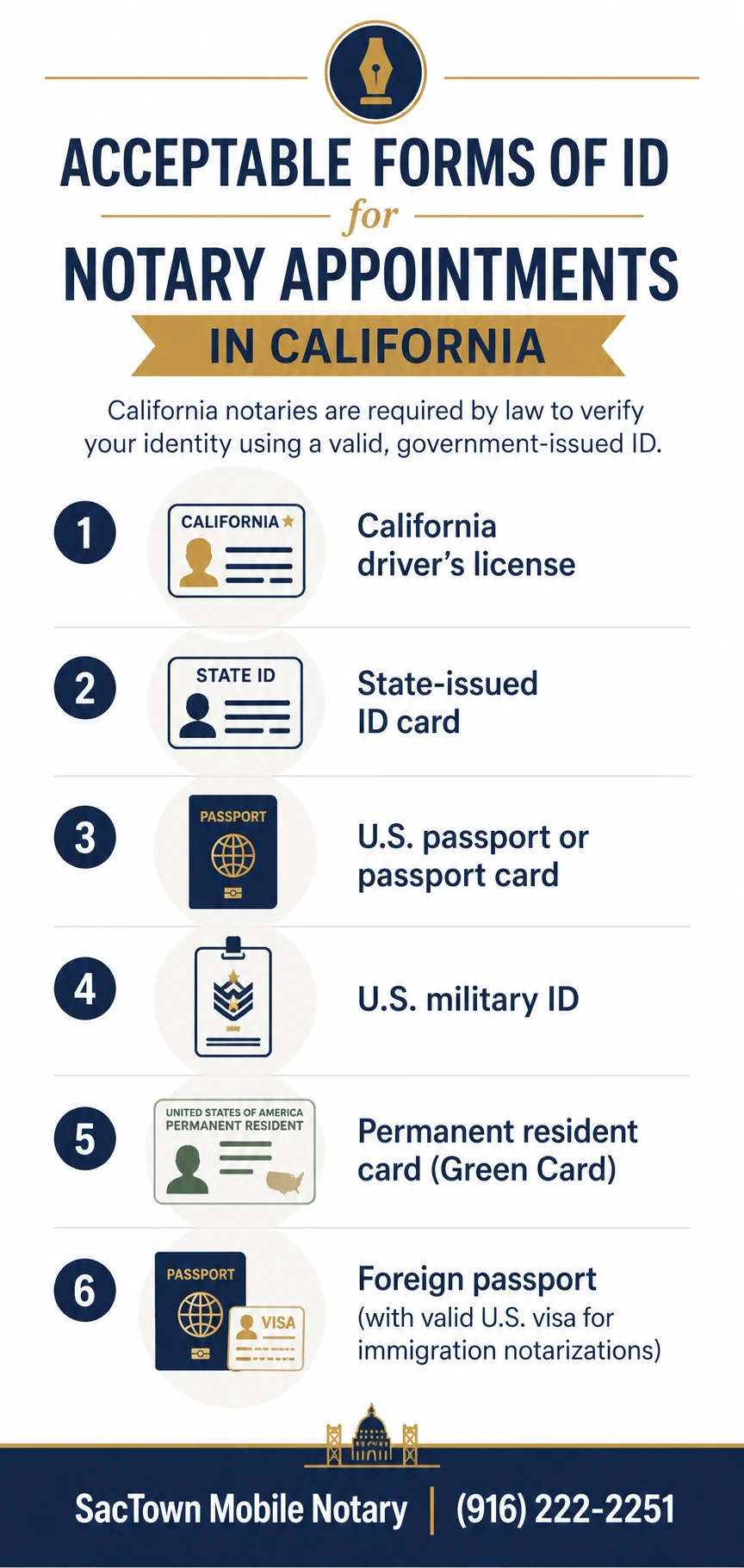
Acceptable Forms of ID
California notaries are required by law to verify your identity at every appointment. Any of these works:
- California driver's license or state ID card, including a DMV senior citizen ID card
- U.S. passport or passport card
- U.S. military ID
- Driver's license or ID card issued by another state
- Passport from your country of citizenship
- Driver's license issued in Canada or Mexico
- Consular ID card
- Employee ID from a California state, city, or county agency
- ID card issued by a federally recognized tribal government
The five-year rule
An ID from the list above still works if it was issued within the last 5 years, even if it has since expired, so a license that ran out last year is usually still fine. Not sure about yours? Call and ask before the appointment.
What California does not accept
These come up a lot, and none of them can be used as your ID:
- Permanent resident card (Green Card). It is not on California's list. There is one narrow exception: if the notarization is only to prepare a form for U.S. immigration, a notary may accept it. For anything else, bring another ID.
- Social Security card, birth certificate, or voter registration card. None of these carry a photo.
- Student ID, credit card, or debit card.
- A photo or photocopy of an ID. The notary has to see the original document.
- An ID that has expired and was issued more than five years ago.
No acceptable ID at all? California allows credible witnesses: one or two people who personally know you, bring their own valid ID, and swear to your identity. Call us first so we can set it up properly.
When you need a notary
Documents That Commonly Need Notarization
Many of California's most important legal documents cannot be accepted by banks, courts, or government agencies without a notary's signature and seal.
Estate Planning
- Living trusts & trust amendments
- Powers of attorney (general, durable, limited)
- Wills & testaments (not required in California)
- Advance health care directives
- HIPAA authorization forms
Real Estate
- Grant deeds & quitclaim deeds
- Deeds of trust
- Title transfer documents
- Seller & buyer closing packages
- Loan modification agreements
This isn't a complete list. A notary can notarize a signature on almost any document. If yours isn't shown here, just call or text us and we'll confirm we can help.
The smarter option
Why Mobile Notary Makes Sense
Traditional notary services require you to drive somewhere during business hours, wait in line, and hope they handle your specific document type. A mobile notary flips that entirely.
Request a Mobile NotaryHome, office, hospital, assisted living, car dealership, anywhere in Sacramento and 5 surrounding counties.
No waiting until Monday. Evening and weekend appointments available throughout the region.
Unlike a UPS Store clerk, our notaries handle estate planning, healthcare directives, and real estate packages.
Simple process
What to Expect at Your Appointment
A typical mobile notary appointment takes 15 to 30 minutes from start to finish.
- Have Your ID Ready
A government-issued photo ID is required — current, or issued within the past five years.
- Don't Sign Yet
Keep your documents unsigned until the notary arrives; some notarizations require you to sign in front of them. Do fill in every section beforehand, though; a notary can't notarize a document with blank spaces.
- Identity Verification
The notary checks your ID, confirms your identity, and reviews the document details.
- Sign & Sealed
You sign in front of the notary. They apply their official seal. Your document is done.
Common questions
Frequently Asked Questions
What does a notary public do?
A notary public is a state-commissioned official who verifies the identity of document signers, witnesses signatures, and applies an official seal to certify that the signing was voluntary and authentic. They are a neutral third party. They do not provide legal advice or prepare documents.
Do I need a notary for a power of attorney in California?
Yes. In California, a durable power of attorney must be either notarized or signed by two adult witnesses (who are not the agent named in the document) to be legally valid. Most attorneys and institutions require notarization. Healthcare powers of attorney have their own specific requirements as well.
What ID do I need for a notary appointment?
You need a government-issued photo ID, such as a California driver's license, state ID card, U.S. passport, or military ID. Under California law the ID must be current, or have been issued within the past five years. California notary law is strict about which documents count, so call us if you are not sure about yours.
Can a notary provide legal advice?
No. A notary public is not an attorney and is legally prohibited from providing legal advice, explaining the meaning of document clauses, or recommending whether you should sign. If you have questions about the content of your documents, consult a licensed attorney before your notary appointment.
How much does notarization cost in California?
California law caps the per-signature notary fee at $15. Mobile notaries may also charge a travel fee. Ours is a flat $50, or $65 for hospitals and care facilities. We are always upfront about fees before your appointment, so there are no hidden charges. We'll confirm the total before we come out. We take cash, credit card, Venmo, PayPal, and Cash App.
Can you notarize a document online or over video?
No, and no other California notary can either. California law requires the signer to personally appear in front of the notary, and the Secretary of State is explicit that a video image is not a personal appearance. A law to allow remote online notarization has passed but has not taken effect. That is exactly what a mobile notary is for: instead of you finding a way to a notary, we come to your home, office, hospital room, or wherever you'd like to meet. One thing people mix up: electronic and remote are not the same. A document can be electronic, but the signer still has to be physically present.
What is the difference between a notary and a signing agent?
A notary public handles general document notarizations. A loan signing agent (also called a notary signing agent) is a notary who has additional training to facilitate mortgage and real estate loan closings. They walk borrowers through loan packages, ensuring every signature and initial is in the correct place.
Ready when you are
Need a Notary in Sacramento?
Our commissioned notaries come to you: home, office, hospital, or anywhere in Sacramento and 5 surrounding counties. Same-day often available.